How Economic Uncertainty Manifests in Payment Defaults Across the Baltics

In recent years, the economic environment in the Baltics has become faster-moving and less predictable. Previously, it took 12–18 months after an economic turning point for payment difficulties among companies and individuals to appear in the payment default register. Today, this happens much sooner — often within 6–9 months, and in some sectors even within a single quarter.
Payment Defaults as an Early Warning
Creditinfo manages the payment default register, which collects daily data from banks, leasing companies, utilities, telecoms, and other businesses. This provides a comprehensive overview of market payment behavior trends.
However, not all payment defaults become publicly visible, which makes the aggregated data in the register a valuable early indicator — showing shifts in the economy before they surface publicly or are reflected in official economic statistics.
Two Waves: Companies First, Individuals Later
Based on payment default data, economic difficulties typically unfold in two phases:
- First, companies. When costs rise or customers delay payments, businesses face liquidity challenges — sometimes visible within a single quarter.
- Then, households. Initially, savings and financial buffers help, but over time, pressure reaches individuals, leading to unpaid bills.
In other words, a rise in company payment defaults often serves as an early warning that the economy is entering a more difficult phase.
Three Countries, Three Speeds
While overall trends are similar across the Baltic countries, shaped by global economic developments, the pace and timing differ:
- Estonia tends to see payment defaults appear more quickly after economic challenges emerge, but both companies and individuals also recover and repay debts faster than elsewhere in the Baltics.
- Latvia shows greater seasonality in debt repayment and reporting across certain sectors compared to its neighbors.
- Lithuania tends to experience risks materializing into payment defaults later than the other Baltic states — reflecting higher resilience — but once defaults occur, they persist longer, meaning problems take more time to resolve.
Which Sectors Show Changes First?
The most sensitive sectors include:
- Construction, where rising costs and changes in financing conditions have an immediate impact.
- Transport, logistics, and wholesale, which quickly feel shifts in the rhythm of the economy.
- Retail and services, where payment difficulties emerge as consumer purchasing power declines.
What Does This Mean for Businesses?
As the economy changes faster than before, annual risk assessments are no longer enough. Companies that regularly use payment default data in evaluating partner and customer credit risk can respond more quickly — by adjusting credit limits, updating terms, or planning sales volumes more realistically.
The era when risks evolved over years is over — today, success belongs to those who spot changes first and adapt fastest.
In Summary
In the Baltics, economic and credit risks now shift quarter by quarter, not year by year. Companies that use payment default data as early warning signals can keep a close eye on their business environment — and stay one step ahead of the market.
Best Practices for How Companies Assess Credit Risk in Their Supply Chains

Effective credit risk assessment is a cornerstone of supply chain management for both global and local companies. With increasingly interconnected trade networks and growing reliance on cross-border suppliers, the financial stability of business partners can directly impact a company’s ability to deliver products and services. A single supplier’s default, bankruptcy, or liquidity crisis can trigger significant disruptions, resulting in delayed deliveries, reputational damage, and even financial loss.
For this reason, organizations across industries are adopting structured approaches to evaluate and monitor supplier credit risk. Below are some of the best practices that companies use to strengthen resilience across their supply chains.
Leveraging Credit Reports and Ratings
The most common practice is the use of credit reports and ratings from specialized agencies such as Dun & Bradstreet, Creditsafe, Creditinfo, Moody’s Analytics, or Experian. These reports consolidate a supplier’s financial history, payment behavior, outstanding obligations, and credit score into an accessible profile.
Such data-driven insights provide companies with an objective assessment of a supplier’s creditworthiness. For instance, Coca-Cola integrates credit data into its supplier evaluation process to ensure that new partnerships are built on reliable financial foundations. By doing so, the company reduces the likelihood of disruptions caused by financially unstable partners and maintains a consistent supply of raw materials.
Conducting Broader Due Diligence Assessments
Credit information alone does not always capture the full picture of a supplier’s risk profile. Many organizations enhance their analysis by conducting comprehensive due diligence assessments that combine financial data with operational, geopolitical, and reputational factors.
Siemens, for example, conducts detailed financial risk analyses as part of its supplier onboarding and monitoring process. The company examines suppliers’ balance sheets, liquidity ratios, and debt structures alongside qualitative factors such as compliance with regulations, corporate governance, and industry-specific risks. The banking sector follows a similar model — institutions such as APS Bank in Malta use financial and non-financial criteria to ensure they collaborate with counterparties that are not only solvent but also reputable and sustainable.
This holistic approach ensures that companies do not overlook hidden vulnerabilities that might undermine supply chain stability.
Continuous Monitoring and Real-Time Alerts
Risk assessment should not be viewed as a one-time exercise. Suppliers’ financial health can change rapidly due to market shocks, regulatory shifts, or internal mismanagement. To address this, companies increasingly adopt continuous monitoring systems that provide real-time tracking of critical credit-related events.
These systems may be embedded in credit rating agencies’ platforms, credit bureaus, or integrated directly into enterprise resource planning (ERP) solutions such as SAP Ariba. They monitor indicators such as late payment patterns, bankruptcy filings, credit downgrades, or sudden declines in liquidity.
For example, Ford Motor Company uses real-time monitoring to detect early warning signs of supplier distress. By acting proactively — whether by diversifying sourcing or negotiating alternative arrangements — Ford minimizes disruptions and protects its production schedules.
Integrating Technology and Analytics
The growing adoption of digital tools has made credit risk assessment more sophisticated. Artificial intelligence (AI), machine learning, and predictive analytics are increasingly used to forecast potential supplier distress before it becomes visible in traditional credit reports. These tools analyze not only financial statements but also alternative data sources such as trade flows, market sentiment, and macroeconomic indicators.
For multinational corporations, this level of insight enables more strategic risk management, while smaller businesses can use simplified versions of these tools to protect themselves against supplier failures. The democratization of credit risk technology is helping local and regional players build more resilient supply chains that were once only feasible for global giants.
Building Resilient Supply Chains Through Credit Risk Practices
By prioritizing structured credit risk evaluation, companies safeguard their operations and strengthen resilience against shocks. Organizations such as Coca-Cola, Siemens, and Ford demonstrate how integrating financial data, due diligence, and continuous monitoring can create supply chains that are both stable and adaptable.
Importantly, this approach is no longer limited to multinationals. Increasingly, smaller and local businesses are adopting similar practices, often supported by affordable credit bureau services, regional data providers, and ERP platforms tailored for SMEs. This shift is especially critical in regions where supply chain disruptions can have amplified effects due to concentrated supplier networks.
Conclusion
Credit risk assessment is more than a compliance exercise — it is a strategic enabler of operational continuity. By leveraging credit reports, conducting broader due diligence, adopting real-time monitoring systems, and embracing new technologies, companies can reduce vulnerabilities and build stronger supplier relationships.
In a global economy marked by volatility and uncertainty, businesses that make credit risk evaluation a core component of supply chain management position themselves to navigate challenges more effectively. Whether multinational or local, organizations that invest in these practices foster resilience, trust, and long-term stability across their supply chains.
Authored by:
Martin Coufal,
Partnership Director, Creditinfo Group.
LLMs Have Transformative Potential in Financial Services and Rely on Teams That Shape Them
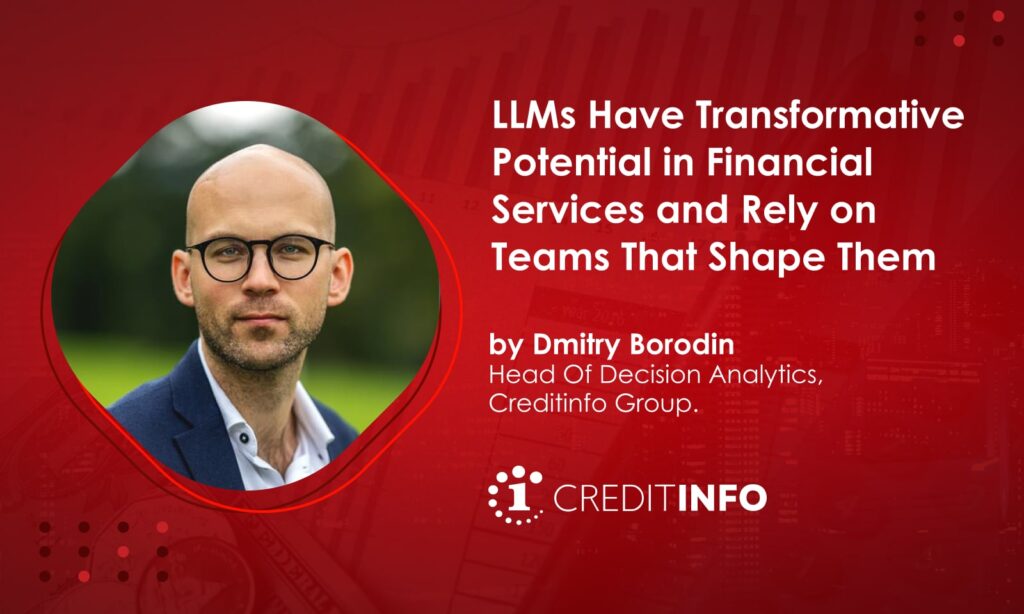
Large language models (LLMs) are disrupting established industries and creating new business opportunities. They can also bring significant value to financial institutions.
While most early implementations have focused on client-facing applications like onboarding, call-center automation and digital assistants, much of LLMs’ potential lies in operational functions. For example, they can:
- Enhance model management by creating model documentation, explaining complex models in plain language and assisting in model validation workflows.
- Boost anomaly detection enabling faster escalation and resolution by human teams.
- Support audit and compliance activities by summarizing model behavior, identifying compliance gaps and documenting evidence for regulators.
- Enhance internal knowledge management by helping staff quickly retrieve information from documents.
These behind-the-scenes applications drive efficiency and free up human teams to focus on strategic decision-making and higher-value tasks. Successful adopters are able to unlock such synergies.
Human-LLM Collaboration
More broadly, human-AI collaboration in finance is evolving. It has become clear that human strengths, such as empathy, judgment and contextual understanding, are critical for high-stakes interactions and that fully autonomous systems still face limitations in certain client-facing roles.
Therefore, financial institutions should focus on building systems allowing AI to enhance, rather than replace human work and allow staff to remain at the center of complex decisions and client relationships. For example:
- Analysts can use LLMs to draft credit assessments, which experts then finalize.
- Compliance officers can use AI to flag suspicious transactions, which are then reviewed by humans applying their expertise and contextual knowledge before escalation.
- Advisors can leverage AI to brainstorm investment strategies, but then deliver advice with empathy and consideration of their clients’ circumstances.
Responsible Rollout
To stay ahead and fully leverage the potential of LLMs while balancing innovation with regulatory requirements, financial institutions should adopt a phased, risk-based approach starting with low-risk, high-value use cases in controlled environments.
As part of this, regular testing in sandbox environments is essential to refine models before wider deployment. Benchmarking LLM outputs against traditional, well-understood models adds another layer of interpretability and reliability. Equally important is continuous human oversight, particularly for impactful decisions where trust, accountability and transparency are necessary.
Looking ahead, institutions must invest in both infrastructure and talent to leverage LLMs responsibly. Scalable computation environments are needed to support LLM training and secure data pipelines are vital for compliant and well-governed data processing. But infrastructure alone is not enough. Success with LLMs will depend on the people behind them. The right mix of machine learning engineers, risk and domain experts, and legal professionals who specialize in AI regulation is needed.
LLMs in financial services are still at an early stage, but with the right mix of technology, processes and talent working toward a shared vision for AI, LLMs can deliver significant value both in and beyond client-facing roles without introducing unnecessary risk.
Creditinfo appoints Charles De Winnaar as Global Head of Sales Strategy and Sales Operations

Former Marsh Africa Sales Leader – Charles De Winnaar – brings a wealth of sales and leadership experience to drive Creditinfo’s international growth
London – 26th September 2024: Creditinfo, a global service provider for credit information and risk management solutions, announces the appointment of Charles De Winnaar as its Global Head of Sales Strategy and Sales Operations. As an experienced sales leader in financial services, Charles will lead Creditinfo’s global sales strategy and operations across its network of 30 credit bureaus. He joins the company from Marsh Africa, where he held the position of Sales & Distribution Leader.
In his role, Charles will be responsible for Creditinfo’s revenue growth, market expansion, and operational excellence to ensure scalability and enhance the customer experience across its different markets. From developing strategic partnerships to driving innovation in sales processes and technologies, he’ll play a key part in the next phase of Creditinfo’s international growth.
With over two decades of experience in sales and finance, Charles has a deep understanding of global financial markets and an impressive history of leading large-scale sales teams, bolstering business growth, implementing customer-centric solutions and transforming sales operations.
As Sales Leader at Marsh Africa, he executed the revenue and portfolio optimisation strategy across multiple Africa regions. Prior to joining Marsh Africa, he held various sales leadership roles at the National Bank of Kuwait and Barclay’s Bank Africa. During his time at Barclays, he led the development and launch of a first-to-market mobile payment wallet lending solution in Africa.
Charles De Winnaar, newly appointed Global Head of Sales Strategy and Sales Operations at Creditinfo said: “I’m delighted to join Creditinfo, a company that is committed to empowering people and businesses through financial inclusion. I look forward to working with the talented global team and contributing to Creditinfo’s long-term success.”
Satrajit Saha, Global CEO at Creditinfo said: “With his unmatched expertise in global markets and a proven track record of building strategic partnerships across different regions, Charles is a valuable addition to our leadership team. As we look to accelerate market expansion, harness digital transformation in our global strategy, and continue to facilitate access to finance for millions of individuals and businesses worldwide, Charles will be instrumental in helping us to achieve these goals.”
Charles will report directly to Satrajit Saha, Creditinfo’s Global CEO.
-END-
About Creditinfo
Established in 1997 and headquartered in London, UK, Creditinfo is a provider of credit information and risk management solutions worldwide. As one of the fastest-growing companies in its field, Creditinfo facilitates access to finance, through intelligent information, software and decision analytics solutions.
With more than 30 credit bureaus running today, Creditinfo has the most considerable global presence in this field of credit risk management, with a significantly greater footprint than competitors. For decades it has provided business information, risk management and credit bureau solutions to some of the largest, lenders, governments and central banks globally to increase financial inclusion and generate economic growth by allowing credit access for SMEs and individuals.
For more information, please visit www.creditinfo.com
Experian MicroAnalytics and Creditinfo unite to launch groundbreaking new fintech solutions

NAIROBI, Kenya, Aug 12, 2024 – Experian MicroAnalytics, a global leader in mobile financial services, and Creditinfo Group, a leading global service provider for credit information and risk management solutions, have partnered to combine Experian MicroAnalytics’ mobile financial services platform with Creditinfo’s scoring models and local market expertise, providing innovative new solutions that facilitate access to finance for individuals and businesses across Africa.
Experian MicroAnalytics, renowned for its risk management solutions utilized by major telcos worldwide, brings its expertise in mobile financial services to the partnership. Their solutions, such as mobile money loans, advanced analytics and machine learning, help to support underserved populations who don’t have access to traditional banking services. Experian’s technology not only facilitates seamless financial transactions but also generates additional revenue streams for telecommunications operators and banks, if present as fund providers.
“Experian is dedicated to driving financial inclusion globally, and our partnership with Creditinfo strengthens our ability to deliver impactful solutions,” said Sammy Hamoudi, General Manager of Experian MicroAnalytics. “Together, we aim to empower telecommunications operators and fintechs to extend their services to previously underserved populations.”
Creditinfo provides comprehensive credit bureau solutions to enable informed decision-making in the financial sector. With this partnership, Creditinfo will further establish itself as the leading credit bureau provider in Africa, enhancing its business risk assessment capabilities and customer insights.
“At Creditinfo, we recognize the transformative power of data-driven solutions in fostering financial inclusion,” stated Kamau Kunyiha, Regional Manager, East and Southern Africa at Creditinfo. “Our collaboration with Experian will help individuals and businesses across Africa gain access to finance, underscoring our shared vision to drive positive change and improve the standards of credit assessment.”
As joint Gold Sponsors of Africa Fintech Festival 2024, Experian MicroAnalytics and Creditinfo showcased their partnership at the event held in Kenya in early June. The festival provided an ideal platform for them to demonstrate their collaborative efforts. Through fireside chats and conference discussions, participants were able to explore opportunities to enhance financial inclusion in Africa through future collaboration.
About Experian MicroAnalytics
Experian MicroAnalytics is a global leader in mobile financial services, providing risk management and marketing solutions to telecom operators and fintechs around the world. Our AI cloud platform increases consumer engagement, reduces churn, manages lending exposure and optimises conversion rates.
With over $4.5 billion in loans already provided by Experian MicroAnalytics, we deliver personalized financial experiences to consumers, empowering financial inclusion while minimizing bad debt.
For more information, please visit www.e-microanalytics.com
About Creditinfo
Established in 1997 and headquartered in London, UK, Creditinfo is a provider of credit information and risk management solutions worldwide. As one of the fastest-growing companies in its field, Creditinfo facilitates access to finance, through intelligent information, software and decision analytics solutions.
With more than 30 credit bureaus running today, Creditinfo has the most considerable global presence in the field of credit risk management. For decades it has provided business information, risk management and credit bureau solutions to some of the largest, lenders, governments and central banks globally to increase financial inclusion and generate economic growth by allowing credit access for SMEs and individuals.
For more information, please visit www.creditinfo.com
Open Banking Solutions at Creditinfo

In 2020 Creditinfo Group decided to be part of the Open Banking initiative by starting to investigate the options of using customers’ bank account statements in their offering. The account information service is based on the PSD2 directive. For known reasons, it is not possible and acceptable to have access to customer bank account data without consent.
Creditinfo have tackled the opportunity in two different ways. In the Baltics and Iceland, the chosen route was to apply for an FSA licence to offer end-to-end customer account statements transfer from their home bank to a third party, from whom the customer applies for credit , e.g. car loan. In the Czech Republic and Slovakia namely due to the long and cost-intensive process of “passporting” CI’s Estonian license, the chosen route was collaboration with a local technical partner called Sokordia Tech.
A little bit more about above-mentioned two ways to offer Open Banking solutions in Creditinfo Group.
In 2021 Spring, Creditinfo Estonia received permission from the Financial Supervision Authority to start offering account information services in Estonia, which later in Autumn expanded to the markets of Latvia and Lithuania. Today, Creditinfo has been offering the account information service in the Baltic market for almost three years. Creditinfo have real-time access to the transaction data of customers of banks and financial institutions using a secure data transmission channel and customer consent.
In Spring 2024, Creditinfo Estonia finalised the Iceland licence application process from Estonian FSA and can officially offer account information service in Iceland.
Beside regulative and compliance part, Creditinfo also has full technical integration and capability in developing categorization when offering account informatoin service. With opportunity to access customers bank account data, the aim is to offer more transparent credit risk evaluation to customers and third parties, who find high value from the knowledge of their customers account information to make data-driven, intelligent credit and business decisions.
As mentioned above, Creditinfo also have Open Banking cooperation and partnership in the Czech Republic and Slovakia with fintech company Sokordia Tech, teaming up to capitalize on Creditinfo’s market position whilst leveraging Sokordia Tech’s AISP and PISP licenses and Open Banking services platform to provide PSD2/Open Banking services to several financial services clients in the market.
In the Czech Republic and Slovakia market, Creditinfo currently has 5 customers utilizing the Open Banking platform, processing more than 1.2 million open banking transactions per month. Depending on the specific requirements, pain points, and use case of the Client, Creditinfo has developed a “Categorization In-a-Box” , Multi-Service platform called Transaction Analysis Service replete with 40,000 pre-installed business rules that can sit atop and work with any Open Banking Open APIs in any country. The service is comprised of 6 unique methods/services (AIS+CIS+PIS) & PDF tools via one API as detailed below:
- PSD2parser: extracting raw data from PSD2 bank statements
- PSD2tags: tag each bank transaction with one to N identifying tags
- PDFparser: Extracting raw data from PDF bank statements
- PDFtags: Tag each bank transaction with one to N identification tags
- 1UnitPay: Verification PSD2 payment (the advantage is that the payment is made in one step with statement extraction)
- Bank Account Views: Repeated viewing of bank accounts without the need for customer re-authentication
Together with our partner Sokordia Tech, we currently have Open Banking APIs and are able to provide all these services under one single API for the following countries: Czech Republic, Slovakia, Hungary, Romania, and Poland.
Development work on the 3rd generation of the Transaction Analysis Service is currently in development, highlighted by:
- Deeper AI involvement in processes & rules & analysis
- Expansion of new online data inputs into transactional analytics
- Multi-language analytical tools
- GUI for clients to manage and report transactional analytics themselves
For more information, please visit: www.creditinfo.com
Authors:
Seth Marks – Regional Director Central, Eastern & Southern Europe, Creditinfo Group
Ivo Vallau – Open Banking Product Manager, Creditinfo Group
An excellent Account Information Service is based on the accuracy of the categorization of transactions

In 2021, Creditinfo Estonia received permission from the Financial Supervision Authority to start offering account information services in Estonia, which later expanded to the markets of Latvia and Lithuania. Today, we have been offering the account information service on the market for almost two years. The account information service is based on the PSD2 directive. We have access to the transaction data of customers of banks and financial institutions using a secure data transmission channel and customer consent.
Account information categorization is the first and most trivial account data processing that creates customer value. In addition to the primary value, categorization is also an input for all subsequent, significantly more value-creating services (for example, debt risk assessment). Without categorization, each time finding, analyzing and displaying value from account information becomes too resource-intensive, so the end user would have to wait a relatively long time to get a result from their data.
Unfortunately, categorization is worthless if the accuracy and quality of the categories are low. Of course, every transaction on a bank account is not an input for assessing a person’s credit risk. When determining credit risk, it is critically important that the accuracy of the categorization of transactions required for analysis is as high as possible. This is to prevent credit losses for companies and overdue debts for private individuals, directly affecting both interest groups’ reputations.
The main input from categorization is related to income
Visit creditinfo.ee/en for more information.
Ivo Vallau
Open Banking Product Manager, Ceditinfo Estonia.
Creditinfo’s Account Information Service Product

In the spring of 2021, the Estonian Financial Supervision Authority authorized Creditinfo Estonia to offer Account Information Service in the Estonian market. In the autumn of 2021, the Estonian Financial Supervision Authority also granted the authorization to provide Account Information Service to the Latvian and Lithuanian markets. This act added to our product portfolio a new, exciting product that benefits our customers in the short and long run. As of today, we have had the Account Information Service in our cross-Baltic product portfolio for two years.
About the Account Information Service
The opportunity to provide Account Information Service emerged when the European Union (EU) Parliament and the EU Council adopted a new directive regulating payment services in the EU internal market on November 25, 2015 (PSD2), which emphasized the expansion of open banking in Europe.
Open Banking refers to provide third-party financial service providers open access to transactional data of bank and financial institution customers, using secure data transmission channels and customer consent.
The Account Information Service is a part of the Open Banking initiative, defined as an online service where the service user (customer) is identified and authenticated via strong identification and authentification means. The service itself means transmitting customer’s bank account data through a secure channel to third party from whom the customer wishes to apply a credit product.
How does Creditinfo provide the Account Information Service?
Using Creditinfo Estonia’s solution, both individuals, which is regulated by the aforementioned payment service directive, and companies can transmit their account information to third parties.
Beside financial sector the possibilities of the Account Information Service can be successfully used in application processes in various sectors. Previously mentioned customer consent is obviously obligatory.
Different sectors that can benefit from account information:
- Public sector companies that provide subsidies to individuals and businesses, where the information in the account details creates significant value when determining subsidies;
- Insurance sector companies, which can use behavioral information from the bank account for determining insurance premiums or simplifying the insurance incident evidence burden;
- Other sectors where value from account information help to create better personalized offers for their products and services.
The strength of our Account Information Service is categorization.
The greatest value of the Account Information Service provided by Creditinfo Estonia comes from categorizing account transactions, which our clients (data recipients) can conveniently use in their business decisions.
Categorization is a solution that can and should be continuously improved over time. Precise and detailed categorization is a top priority for Creditinfo Estonia’s Account Information Service.
The data from the Account Information Service serves also as an input for our Account Information Service Report. The report helps to make more informed business decisions both internally and towards our client’s customers. The report highlights all the key ratios, indicators, “green and red flags” and much more that can be extracted from account information.
The report is designed in a way that can be customized to meet the client’s needs, which make it a tool for everyday business decisions.
More information about the service: https://creditinfo.ee/en/avoid-debts/psd2/
Risk Management Framework

Risk management is an essential function for any bank, as it helps to protect the bank’s financial position, reputation, and long-term viability. An effective risk management framework consists of several key components that work together to identify, assess, and manage risks.
Risk Governance
The first key component of an effective risk management framework is risk governance. This involves establishing clear risk management policies, procedures, and guidelines that align with the bank’s overall strategy and objectives. The bank’s board of directors and senior management should be actively involved in setting risk management policies and overseeing the bank’s risk management activities.
Risk Identification
The second key component is risk identification. The bank should have a comprehensive risk identification process in place to identify all potential risks associated with its business activities, products, and services. This includes identifying internal and external risks such as credit risk, operational risk, market risk, and compliance risk.
Risk Assessment
Once risks are identified, the bank should assess the likelihood and impact of each identified risk to determine its potential impact on the bank’s overall operations, financial position, and reputation. This includes assessing the potential impact of risks on the bank’s customers, employees, and other stakeholders.
Risk Mitigation
The bank should develop and implement risk mitigation strategies to manage and reduce the likelihood and impact of identified risks. This may include implementing internal controls, establishing risk limits, and developing contingency plans.
Risk Monitoring
An effective risk management framework should include ongoing risk monitoring to ensure that the framework is functioning as intended. This involves continuously monitoring the bank’s risk management activities to identify emerging risks and ensure that existing risks are being effectively managed.
Risk Reporting
The bank should have a robust risk reporting framework in place to provide timely and accurate information on risk exposures and mitigation activities to the board of directors, senior management, and other stakeholders. Effective risk reporting helps ensure that the bank’s management team has the information they need to make informed decisions about risk management activities.
Risk Culture
Finally, an effective risk management framework should foster a risk-aware culture throughout the organization. This involves ensuring that all employees understand their roles and responsibilities in managing risks and are held accountable for their actions. A strong risk culture helps to ensure that risk management activities are integrated into the bank’s day-to-day operations.
In conclusion, an effective risk management framework is essential for banks to identify, assess, and manage risks. The key components of such a framework include risk governance, risk identification, risk assessment, risk mitigation, risk monitoring, risk reporting, and risk culture. By implementing an effective risk management framework, banks can effectively manage risks and protect their financial position, reputation, and long-term viability.
Joe Bowerbank,
Business Development, Creditinfo Group.
Creditinfo completes strategic acquisition of Ugandan and Namibian credit bureaus

Latest acquisitions cement credit expert’s position as leading solutions provider in Africa.
Kampala and Windhoek/London, 25th May 2023 – Creditinfo Group, the leading global service provider for credit information and risk management solutions, today announces the acquisition of two credit bureaus in Uganda and Namibia. As part of the acquisition, Creditinfo has taken on all employees working in the credit bureaus, which were previously owned by Experian. Creditinfo will combine their invaluable local expertise with its own extensive experience in delivering private credit solutions to African and European nations to help millions access finance.
Creditinfo has a unique mix of market knowledge that it will draw on to complement the work of the strong management teams already in place in Namibia and Uganda. Its experience working with more traditional lending markets in Europe combined with its knowledge of the different trends in lending markets in sub-Saharan Africa – such as the drive-in mobile wallet use in Kenya – will help both Namibia’s and Uganda’s credit bureaus go from strength to strength.
Coupling this experience with its advanced software and analytics products, Creditinfo will deliver its world-leading credit bureau solutions to help the two bureaus facilitate access to finance for both individuals, SMEs, and corporates in the regions, whatever their social and economic needs.
Paul Randall, CEO at Creditinfo said: “We are committed to sustainably growing our business and identifying ideal opportunities to add strong and profitable credit bureaus to the Creditinfo Group, while helping more local citizens and businesses access finance. Uganda and Namibia are ideal partners for us in this respect and all our new employees are a credit to the Creditinfo name. As the leading credit bureau provider in Africa, we eagerly look forward to working together to provide the best service possible in each country”.
Mark Charles Mwanje, Country Manager of Uganda said: “We are delighted to join the Creditinfo Group. We believe their years of expertise and knowledge will be a great asset to our existing team of dedicated and talented employees. We look forward to joining forces to help the local people and our growing economy.”
Karin Jansen van Vuuren, Country Manager of Namibia said: “Working with Creditinfo provides us the chance to tap into new opportunities for further growth. The company’s in-depth experience will be instrumental in helping banks and other lenders to extend credit, while ensuring we’re still a private credit bureau run by local people for local people, with all their best interests at heart.”
-ENDS-
About Creditinfo
Established in 1997 and headquartered in London, UK, Creditinfo is a provider of credit information and risk management solutions worldwide. As one of the fastest-growing companies in its field, Creditinfo facilitates access to finance, through intelligent information, software, and decision analytics solutions.
With more than 30 credit bureaus running today, Creditinfo has the most considerable global presence in this field of credit risk management. For decades it has provided business information, risk management and credit bureau solutions to some of the largest, lenders, governments, and central banks globally to increase financial inclusion and generate economic growth by allowing credit access for SMEs and individuals.
For more information, please visit www.creditinfo.com