Credit Bureaus and why they will remain important in the years to come

As the financial industry continues to evolve, credit bureaus need to continue to adapt. There are many compelling reasons why credit bureaus will continue to play a vital role in the future of lending and credit. In this blog, we’ll explore the benefits of credit bureaus and why they will remain important in the years to come.
1. Efficient and standardized credit data
Credit bureaus provide an efficient and standardized way to collect and store credit data. This allows lenders to quickly access the credit history and credit scores of potential borrowers, which is essential for making informed lending decisions. Without credit bureaus, lenders would need to spend more time and resources gathering credit data from various sources, which would slow down the lending process.
2. More accurate credit models
Credit bureaus are constantly refining their credit models to improve accuracy and predictiveness. By analysing large amounts of credit data, credit bureaus can develop more sophisticated credit models that consider a wide range of factors, such as payment histories, outstanding debts, and length of credit history. These models provide lenders with a more accurate picture of a borrower’s creditworthiness, helping to reduce the risk of defaults and delinquencies.
3. Increased access to credit
Credit bureaus play a critical role in expanding access to credit. By providing lenders with access to credit data, credit bureaus make it easier for individuals and businesses to obtain loans and credit cards. This is particularly important for people with limited credit histories or who have had past credit problems, as credit bureaus provide lenders with a way to evaluate these borrowers’ creditworthiness.
4. Protection against fraud and identity theft
Credit bureaus also play a key role in protecting consumers against fraud and identity theft. By monitoring credit reports for suspicious activity, credit bureaus can help detect and prevent fraudulent activity. Additionally, credit freezes and fraud alerts can be placed on credit reports to prevent unauthorized access to credit data.
5. Continued relevance in a changing industry
While the financial industry is evolving rapidly, credit bureaus will continue to be relevant in the future. As new technologies and data sources emerge, credit bureaus will adapt and incorporate these changes into their credit models. Additionally, credit bureaus will likely face increased competition from fintech startups and other companies, which will push them to innovate and improve their offerings.
In conclusion, credit bureaus are essential to the lending and credit industry. By providing lenders with access to credit data, credit bureaus make it easier for individuals and businesses to obtain loans and credit cards. Additionally, credit bureaus play a critical role in expanding access to credit, protecting consumers against fraud and identity theft, and adapting to a changing industry. As the financial industry continues to evolve, credit bureaus will remain a vital part of the lending and credit ecosystem.
Gary Brown,
Head of Commercial Development, Creditinfo Group.
The Role of Artificial Intelligence and Machine Learning in Credit Scoring

Executive Summary
The use of artificial intelligence (AI) and machine learning (ML) in credit scoring is revolutionizing the lending industry. By leveraging vast amounts of data and advanced algorithms, lenders are able to more accurately predict credit risk, improve operational efficiency, and expand access to credit for underbanked individuals and small businesses. This white paper explores the benefits and challenges of AI and ML credit scoring, and provides guidance for lenders on how to successfully integrate these technologies into their lending processes.
Introduction
Traditional credit scoring models rely on a limited set of data points, such as payment history, outstanding debt, and length of credit history, to assess creditworthiness. These models are effective for many borrowers, but they can be limiting for individuals with thin credit files or non-traditional sources of income. AI and ML credit scoring models, on the other hand, can analyze a vast array of data points, including non-traditional data sources, to develop a more accurate and comprehensive picture of a borrower’s creditworthiness.
Benefits of AI and ML Credit Scoring:
1. Improved accuracy: AI and ML algorithms can analyze a wide range of data points, including non-traditional data sources such as social media activity and utility bill payments, to develop a more accurate picture of a borrower’s creditworthiness. This can result in more accurate credit scores and better loan decisions.
2. Expanded access to credit: Traditional credit scoring models can be limiting for individuals with thin credit files or non-traditional sources of income. By analyzing a broader range of data points, AI and ML credit scoring models can expand access to credit for underbanked individuals and small businesses.
3. Increased efficiency: AI and ML credit scoring models can automate many aspects of the lending process, reducing the need for manual underwriting and improving operational efficiency. This can result in faster loan decisions and a better borrower experience.
Challenges of AI and ML Credit Scoring:
1. Data privacy and security: As AI and ML credit scoring models rely on vast amounts of data, data privacy and security are critical concerns. Lenders must ensure that they are collecting and using data in compliance with applicable laws and regulations, and that they have robust cybersecurity measures in place to protect sensitive borrower data.
2. Bias and discrimination: AI and ML algorithms are only as good as the data they are trained on, and if that data is biased, the algorithms can perpetuate that bias. Lenders must be mindful of potential biases in their data and take steps to mitigate any potential discrimination in their lending decisions.
3. Explainability: AI and ML algorithms can be complex and difficult to interpret, which can make it challenging for lenders to explain their lending decisions to borrowers. Lenders must be able to provide clear explanations of their credit scoring models and lending decisions to borrowers.
Conclusion
AI and ML credit scoring has the potential to revolutionize the lending industry, providing more accurate credit scores, expanding access to credit, and improving operational efficiency. However, lenders must be mindful of the potential challenges, including data privacy and security, bias and discrimination, and explainability, and take steps to mitigate these risks. By investing in AI and ML technologies and developing robust risk management practices, lenders can successfully integrate these technologies into their lending processes and provide better loan decisions and a better borrower experience.
Samuel White
Director of Direct Marekts, Creditinfo Group.
Kredītinformācijas Birojs and Citadel Bank Sign an Agreement to make It easier for Ukrainian citizens to receive Financial Services

It has already been reported that last year the “Credit Information Bureau” of Latvia (KIB) concluded an agreement with the “International Credit Information Bureau” in Ukraine ( Мидрождение бюро кредитних історий ) on the exchange of credit history data of Ukrainian nationals.
The fintech movement in the banking industry

Is fintech an enabler or disruptor in the banking industry? Fintech the new technology that improves and digitalizes the delivery and services of the banking industry. These solutions can include software helping connect with customers, businesses, and banks through agile processes to manage financial services better. Or better use of data to offer a more personalized and customer centric offering.
The lending landscape has gone through some major changes in recent years, and this shift does not appear to be slowing down. Based on the latest information from the World Bank, about 76% of adults have a bank or mobile account, this is up from 51% in just over a decade. The rise of mobile money solutions, which allow users to turn their smartphones in digital wallets and use it to pay for services, have played an important role tapping into the unbanked segment and supporting this improvement.
Fintechs are realizing the opportunities to disrupt the challenges faced by traditional banking and offering new solutions that better suit the needs of customers and businesses. By embracing technology, fintech companies can collect and store more data on customers so they can offer personalized solutions with greater choice of products. Unlike traditional banks, fintechs can move with speed and deliver digital solutions improving the user experience.
The increase in fintech players has increased competition between traditional banks and fintechs. Traditional banks are paving the way to collaborate with fintechs while others are implementing teams to focus on in-house projects. Older generation customers may value trust over the latest trends and will therefore remain loyal customers to traditional banks., However, younger generations will demand more and swifter solutions because that is what they are familiar with. Traditional banks embracing fintech solutions will see them provide the flexible solutions that customers are looking for.
One of the biggest reason the banking industry has adapted to fintechs, is due to their ability to connect with customers 24/7 through an omnichannel approach. This not only increases customer reach and convenience but also allows banks not to rely solely on customers visiting a branch.
It is expected that we will continue to see changes in the banking industry for years to come, the speed of change will depend on how much and how fast customers continue to adapt to fintech solutions. It’s clear, traditional banks are no longer the monopoly in this industry, with more digital banks, neo– banks and new players such as telcos and payment companies entering the lending landscape. Nobody is expecting the traditional banks to be replaced but it is likely that banks and fintechs partnering with one another will allow the traditional banks to enhance technologies and by coming together both the fintechs and the banks can benefit in this highly competitive market.
Samuel White,
Direct Markets Director, Creditinfo Group.
Evolution of customer onboarding and risk assessment

This year, Creditinfo celebrated its 25-year anniversary, so I decided to look back on how the landscape in effective credit risk management has evolved.
While it was a little before my time, I’m sure there are still many people today who remember that the only way to open a bank account, apply for a loan or to be considered for a mortgage was to visit your local branch and sit with a loan officer. Though, this is still the case in many emerging markets even today, there will be some small differences on the data used and the risk assessment criteria that is in place.
Historically, a visit to the branch would involve meeting a loan officer who would then try to understand your circumstances before making an approval. If there was a past relationship or a connection (family member, friend, etc) with the loan officer, this would usually work in your favor. It was a direct relationship that usually lasted a lifetime. The loan officer would know or at least try to understand as much personal information on your employment, income, and expenses as possible and then would make a personal judgement to provide you with a form of credit. All of this was most likely completed and documented on papers and filed into a filing system for record.
Fast forward a few decades and not only are local branches disappearing, but also the idea of sharing personal information with a “stranger”, along with any supporting documents that validate your circumstances are a thing of the past. In a world of smartphones, tablets, and access to the internet 24/7, we have moved to a new wave of digital lending.
Lenders are implementing new strategies today to meet the end needs of customers by enabling access to credit instantly at their fingertips. Digitalization has become the new norm in lending and to succeed today, lenders need to adjust and transform their platforms. It is now a thing of the past to fill in an application form on paper when we have a smartphone in our pockets that can allow us to fill in the same information into a mobile application within a few minutes. As part of the loan onboarding, we can now validate our identity through biometric authentication options – fingerprint analysis, selfie/face recognition and document validation, etc. eliminating the need to do human to human verification.
The challenges from old-fashioned lending methods, i.e. understanding family ties or seeking information on employment and income would typically result in an unfair and inaccurate risk assessment. With the vast amount of information available today, either traditional or non-traditional, we can accurately assess everyone, even customers with limited credit history – “thin files”. These are often rejected due to the lack of evidence on how risk-tolerant or risk-averse they are. Usually, the absence of traditional information for these customers creates a challenge for them to receive the financial support they need. With the introduction of psychometric data, e-wallet data or open banking solutions, lenders can combine credit scoring methods with traditional models to provide accurate and reliable risk assessment.
The benefits and success of this digital transformation and innovative approach to lending is not just about delivering quick-fix money solutions. Instead, it is about empowering individuals, facilitating access to credit and growing our global economies.
If you are interested to reach the top and win the digital race with a state-of-the-art digital lending platform then reach out to Gary Brown, Commercial Director, Creditinfo Group.
Visit www.creditinfo.com for more information.
Paving the way for a brighter future through SME lending
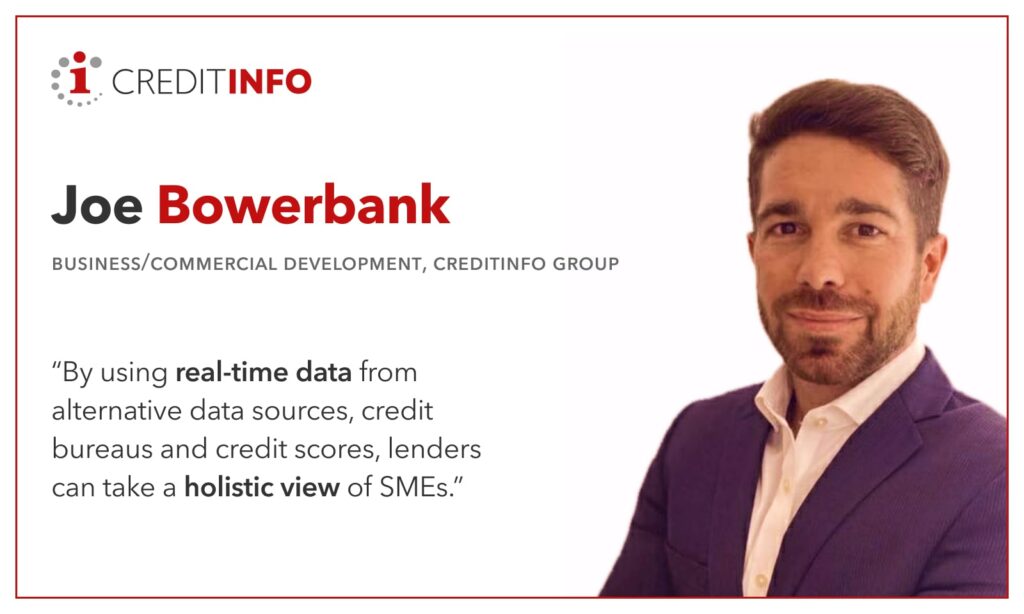
Developing modern solutions and removing barriers, paves the way for a brighter future through SME lending
SMEs (Small and Medium-sized Enterprises) are known as one of the biggest business sectors in each economy, being important contributors to job creation and global economic development. They create more than 50% of employment worldwide.
SMEs have gained importance in developing economies. Although SMEs have some weaknesses, they are less affected by economic crises due to their flexibility and ability to keep up with changing conditions. SMEs are vital establishments to create an effective innovation ecosystemThis is shown by recent studies that SME’s can contribute to over 55% of GDP and over 50% of total employment.
SMEs can find it increasingly difficult to borrow money from traditional banks because of strict requirements. It is often seen that SMEs are riskier than large institutions as it is difficult for banks to evaluate them in the same way since they often do not have solid accounting systems. This difficulty in assessing their creditworthiness often impacts the bank’s ability to provide affordable credit. As a result, many SMEs are forced to look at alternative solutions such as expensive credit lines charging high interest rates or offering costly collateral. Neither of these options are sustainable for small businesses.
SMEs need fast decisions and a more agile, digital approach. This is where Creditinfo and local Fintechs are working in collaboration to support the sector. Together, we specialize in using technology to quickly assess each SME’s entire data footprint and then provide tailored financial solutions. Based on our experience in Africa, we can assess the credit risk an SME poses by using real-time data from multiple sources, including e-wallets, credit bureaus and credit scores. The traditional method, consisting of manual processes and hard copies, is now an outdated approach in the digital world.
Digital SME finance, using alternative data, offers an extraordinary opportunity for addressing some of the challenges. Every time SMEs and their customers use digital services, conduct banking transactions, make or accept digital payments, use their mobile phones, or manage their receivables and payables through a digital platform, they create alternative data. This real-time and verified data can be analyzed to determine both capacity and willingness to repay loans.
Specific SME assessment methodology can also be applied. For example, small companies tend to have a greater level of owner centricity. Therefore, blending business and personal data can enable the development of highly predictive blended scorecards that utilize the payment behaviour of business owners and managers and company credit data to produce a more comprehensive risk assessment.
Help is also needed from Central Banks to continue to support this sector. We are seeing reforms happening globally where Central Banks are implementing mandates for all banks to lend a set percentage of their credit portfolios to SMEs. Boosting the availability of finance for the SME sector, the reforms aim to ease the flow and reduce the high cost of credit to a sector that is considered an engine of growth for the future.
SME lending is rapidly growing, and by putting the customer needs first and using new solutions and data, we can begin to shift the status quo. Globally there is a shift toward digital lending solutions, which can support a level playing field for SMEs. By transforming this lending sector as a whole, we can make it more accessible for small businesses to grow and continue making a difference.
Joe Bowerbank – Business/Commercial Development, Creditinfo Group.
Angola’s first licensed credit bureau in partnership with Creditinfo to provide millions with access to finance

- Private credit bureau will support responsible lending and economic growth
- Millions of unbanked citizens and small businesses to gain access to lending for the first time
Luanda/London, 16th May 2022 – Creditinfo Group, the leading global service provider for credit information and risk management solutions, today announces plans to open Angola’s first licensed credit bureau, with Bureau Central Privada de Informação de Crédito SA (Bureau). This long-term strategic partnership, represents a vote of confidence and major investment into Angola’s buoyant economy, unlocking access to credit for millions of micro-to-medium sized businesses and citizens – many of whom are currently unbanked.
To deliver a world-leading private credit bureau solution, Creditinfo will combine Bureau‘s local knowledge with its own extensive experience delivering private credit bureau solutions in developing markets – including across Sub-Saharan Africa. The project’s initial remit will include Creditinfo’s most popular products and services, including CBS. Based on market appetite, further value-added products will be introduced.
Samúel White, Regional Director at Creditinfo said: “Accessing credit has long been a challenge across Sub-Saharan Africa. By opening Angola’s first private credit bureau, we’ll enable banks and other lenders to extend credit to citizens and businesses, helping to build and develop its already thriving economy. Supporting the unbanked to access finance requires a specific set of experiences and insights which Creditinfo has honed over decades of working across the region. We’re proud to be a leader in this space and can’t wait to open for another dynamic market together with our strategic partners.”
Cristiano Monnerat, Director at Bureau Central Privada de Informação de Crédito S.A. added: “Boasting significant untapped opportunities for wealth creation and a young, dynamic population, Angola represents an attractive investment for us. As such, we’re excited to be able to draw on Creditinfo’s global expertise to build a private credit bureau that’s run by local people, for local people. All in all, this marks a major step forward for Angola’s growing economy.”
-ENDS-
About Creditinfo
Established in 1997 and headquartered in Reykjavík, Iceland, Creditinfo is a provider of credit information and risk management solutions worldwide. As one of the fastest-growing companies in its field, Creditinfo facilitates access to finance, through intelligent information, software and decision analytics solutions.
With more than 30 credit bureaus running today, Creditinfo has the most considerable global presence in this field of credit risk management, with a significantly greater footprint than competitors. For
decades it has provided business information, risk management and credit bureau solutions to some of the largest, lenders, governments and central banks globally to increase financial inclusion and generate economic growth by allowing credit access for SMEs and individuals. For more information, please visit www.creditinfo.com
About Bureau Central Privada de Informação de Crédito S.A.
Established in 2021, the Bureau Central Privada de Informação de Crédito S.A. (Bureau) supports access to finance in Angola – with a focus on underserved segments of society with no formal access to credit facilities. Bureau is led by a highly qualified team of Brazilian advisors based in Angola. In February 2022, the Bureau received its operational license from the Central Bank of Angola, fulfilling all of the legislative and regulatory requirements.
The long-term strategic partnership with Creditinfo Group will provide Bureau with the necessary insights and industry best practices from similar markets to increase economic growth and improve financial inclusion across Angola.
Media Contacts:
Jack Benda
Red Lorry Yellow Lorry for Creditinfo Group creditinfo@rlyl.com
+44 (0)7760 291 679
Top trends that will shape banking in 2022

We sat down with our Direct Markets Director at Creditinfo Group, Samuel White, to discuss some of the key trends that will shape banking in the MENA and Asia region. These were some of his thoughts:
New market players from non-traditional lenders such as telco or payment providers
We are seeing an increasingly number of non-banks entering the markets. There has been a clear sign that these companies have a wealth of internal data through their platforms and usually e-wallet transactions. It has been proven that this data is extremely valuable during the risk assessment process.
SME finance
SMEs are playing an instrumental role in local economies but still struggle to receive the access to banking products in a timely fashion. In the region every country is looking at how better to serve these customers and provide them with the solutions they require.
Digital Banks, Neo Banks, Born Digital Banks
Many of the traditional lenders are based on legacy technologies and we have seen an accelerated approach to digital transformation over the last 2 years. We have also seen some banks create new digital arms to their organization setup with new technology away from legacy portfolios. These Born Digital Banks are increasing in the region, and anybody left behind can expect to lose some market share in the future.
BNPL
Buy Now Pay Later (or as some are calling it Save now pay later) is not a new concept but there is no doubt it is growing with popularity. The demand for flexible payment offerings is at an all-time high. Typically, these smaller value loans are based on impulse buying so lenders must make sure they have the process in place to offer instant decisioning.
We also asked him how Creditinfo is playing a role in shaping these trends:
How is Creditinfo helping banks lead in the digital era?
At Creditinfo we are focusing on helping banks streamline and improve the credit process across the full credit lifecycle, from origination through scoring, risk, decisioning and portfolio management. We are offering enhanced digital channels to meet the customer demands and reach the underserved or unbanked segments. We recognize it has become more accessible for individuals and SMEs to make use of digital financial services and by working with Banks we can develop software and applications to deliver services that are more transparent and automated.
What is Creditinfo’s business model and how do you see this model shaping the banking industry?
Creditinfo is a provider of credit information and risk management solutions worldwide, one of our primary goals is to help facilitate access to finance. We have built credit bureaus globally and across different markets, giving us key insights and knowledge into best practices. Creditinfo has a vision to create successful partnerships with lenders, governments, central banks to help increase financial inclusion and generate economic growth by allowing credit access for individuals and SMEs.
Creditinfo wants to continue building products and working with partners to add further solutions and data to enable lenders to further lend in a responsible fashion. Lenders are shifting their attitude towards FinTechs to keep pace with change and remain competitive. There is a huge variety of FinTech offerings available today using wide range of data that’s delivered through applications to provide lending decisions in only a few seconds.
Creditinfo Gulf and Tech Access Strategic Partnership

Creditinfo Gulf and Tech Access joined forces and announced a strategic partnership to enhance risk assessment and facilitate access to finance in the MENA region.
Both companies will help Lenders and Tech firms streamline the risk assessment process and increase credit quality, earnings and growth while mitigating credit risk.
Creditinfo is a leading service provider for credit information and risk management solutions worldwide. It has established more than 33 credit bureaus in mature and emerging markets over 4 continents, thus tangibly contributing to growing and strengthening economies.
Tech Access has become an acknowledged industry leader in the ICT enterprise distribution market in the MENA region. Providing technology solutions to large Govt., private and public corporations across UAE, KSA, Pakistan, Levant & Africa regions.
“Our partnership, comprised with Creditinfo Gulf, is to enhance our local and regional coverage on credit information and fintech service provider across the globe, offering cutting-edge analytical tools and software solutions for the financial industry for efficient credit risk and strategic decision making” commented Jawwad Rehman, CEO Tech Access.
“This announcement marks another significant milestone, and we are excited to start this new partnership with Tech Access to provide full potential of intelligent information, software and analytics solutions. Supported by international know-how and local market support, setting a remarkable high bar in the MENA region. We look forward to working with Tech Access and Financial Lenders to deliver these capabilities.” commented Gary Brown, Managing Director Creditinfo Gulf
Ends.
Creditinfo awarded contract as the service provider for the Credit Information System of Seychelles

Creditinfo to establish a new Credit Information System for the country.
London, UK – 11th January 2022: Creditinfo Group, the leading global credit information and decision analytics solutions provider, today announced that it has signed a contract to design, implement and support a new Credit Information System (CIS) for the Central Bank of Seychelles (CBS).
The contract – which will see Creditinfo’s solution rolled out over the next 12 months – makes CBS the 10th central bank to procure a credit information solution from the company.
At the end of 2020, the Seychelles population stood at 98,963, out of which there were approximately 20,099 active retail credit consumers. Seven commercial banks, all licensed and regulated by CBS, are currently the main institutions granting credit facilities to customers. A local credit union and two micro-finance institutions, also supervised by CBS, are the other major providers of credit facilities.
One of the recommendations in Seychelles’ Financial Sector Development Implementation Plan adopted in 2014 was the need to enhance the effectiveness of the existing CIS operated by CBS, inclusive of broadening the scope for the capture of information across all relevant credit providers. In this context, CBS initiated a tender process in April 2021, inviting credit information solutions providers to submit proposals to develop and implement a new CIS. The contract has ultimately been awarded to Creditinfo.
The solution will include scoring, benchmarking, and the implementation of external data sources. Creditinfo will also provide training, consultancy and ongoing support services for the management of the system over the next five years to ensure that CBS employees, local lenders and data providers have the necessary knowledge to make the new CIS a successful endeavor.
Once established, the new CIS will support existing lenders and, over time, onboard other credit data providers, including fintech companies, state-owned enterprises, hire purchase providers, credit sales and financial leasing companies, insurance companies, amongst others. Hence, the new and expanded CIS will support the incorporation of additional data to supplement traditional sources and ultimately provide more individuals and businesses with the financing needed to realize their goals and grow the economy. In addition, the enhanced system will assist the overall mitigation of credit risk.
Samuel White, Regional Director at Creditinfo commented: “While the Central Bank of Seychelles currently has a credit information system in place, it doesn’t meet the market needs of today, and certainly doesn’t enable it to realize the future ambitions of the country and its economy. We’re delighted to win this tender to put in place the technology and knowledge base to help open doors for individuals and small and medium-sized enterprises by increasing access to credit.
We see huge untapped potential in the market, and we are excited to work with our 10th central bank customer to establish a credit information system fit for the future. Once operational, this new system will enable more responsible lending by empowering local credit providers with the data they need to ensure they manage lending risks appropriately, ultimately boosting access to finance for individuals and small businesses.”
Caroline Abel, Governor, Central Bank of Seychelles, said: “Seychelles has a vibrant financial services ecosystem, and access to credit is an important aspect as we look to boost financial inclusion in the market and look at ways to grow our economy. At the same time, lenders should have access to appropriate data to have a better overview of the creditworthiness of borrowers, be able to assess credit risks and make sound financial decisions. Information collected through such a system can also be used for analysis and monitoring in the areas of financial inclusion and stability.
The CBS is therefore looking forward to the collaboration with Creditinfo over the next five years to have a modern credit information system that is in line with industry standards, ultimately assisting the development of the credit environment and overall financial sector.”
Paul Randall, CEO of Creditinfo Group added: “Creditinfo has been effective in strengthening the financial infrastructure in numerous countries across the world, and working with central banks to create a robust and fair way to assess risk and credit affordability. We are looking forward to supporting the Central Bank of Seychelles with their implementation of a future-looking credit information solution and widening access to the information and financing that will be key to future business and economic growth in the country.”
-ENDS-
About Creditinfo
Established in 1997 and headquartered in London, UK, Creditinfo is a provider of credit information and risk management solutions worldwide. As one of the fastest-growing companies in its field, Creditinfo facilitates access to finance, through intelligent information, software and analytics solutions.
With more than 30 credit bureaus running today, Creditinfo has the largest global presence in the field of credit risk management, with a significantly greater footprint than competitors. For decades it has provided business information, risk management and credit bureau solutions to some of the largest lenders, governments and central banks globally – all with the aim of increasing financial inclusion and generating economic growth by allowing credit access for SMEs and individuals.
For more information, please visit www.creditinfo.com
Media Contacts:
Matt Silver
Babel PR for Creditinfo Group
+44 (0)20 7199 3997