Interview with Catherine Muraga, CIO – Stanbic Bank Kenya

We interviewed Catherine Muraga the Chief Information Officer (CIO) at Stanbic Bank Kenya – one of the largest banks in Africa. Catherine is well versed with the Information Technology (IT) landscape having worked in different industry sectors including Manufacturing, Airline and Banking industry. She provides strategic vision and operational IT leadership for the Information Technology Department and controlling all IT functions. We asked her a few questions around COVID-19 and how Stanbic Bank is working around this pandemic.
Creditinfo’s “CIP Score” Between evolution and improvement: a powerful tool for risk management in a more digital financial environment

The core business of commercial banks and other lenders, at the most basic level, is to sell money. To loan an amount with a negotiated re-payment schedule with interest, is a process that allows the economy to finance itself. But for this cycle to be sustainable in the long term, it must be carried out with both vigilance and responsibility. The “credit risk” of a client, their probability of reimbursement, and differentiating between “good” and “bad” clients are basic yet essential elements to loan in a profitable and durable manner.
The evolution of retail credit in the banking sector in UEMOA

Covid – 19 has hit the world with a “double shock”: an unprecedented contraction in supply and demand coupled with a health-economic conundrum. For Africa, and the UEMOA region, the immediate picture is bleak. However, there is hope if the financial sector uses the situation as a trigger for accelerated transformation of lending processes and products, taking the lead from other sub-Saharan markets and levering advantage of the robust financial infrastructure in place.
Proactive Portfolio Management

The world is currently facing unprecedented economic challenges resulting from the COVID-19 pandemic. This was initially reflected in drops in oil prices, followed by the falling stock market and more recently employment levels. Research by the UN suggests global GDP is likely to shrink by around one per cent this year and could contract further if restrictions on economic activity extend beyond the second quarter.
Thanks to Creditinfo, Estonia becomes the competence center of open banking
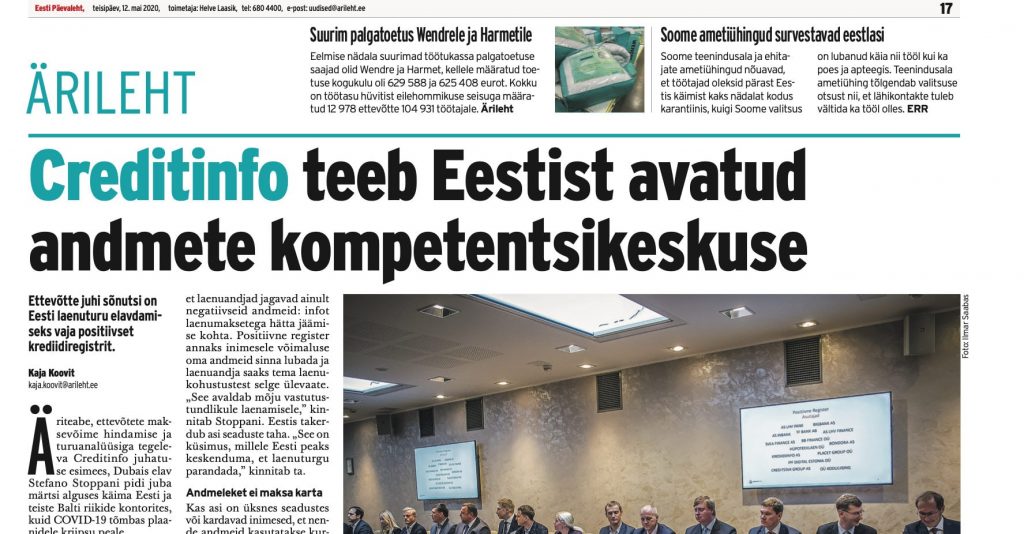
The Head of the company says a positive credit register is needed for boosting the Estonian credit market. Stefano Stoppani, Dubai-based Chairman of the Board of Creditinfo providing business information, solvency assessment and market analysis, intended to visit its offices in Estonia and the other Baltic countries in the beginning of March, but COVID-19 hampered with these plans. Europe is cautious in regulating both data protection and open banking. The aim of the PSD2 directive is to give third parties – licensed companies – access to a person’s bank account information. This is not done just because, but for providing better service, and obviously the account holder must authorize this. The third-party, for example, the creditor, can then see the income of the person and what the money is spent on. Information is needed to determine if the person is able to pay back the loan (s)he wants.
Creditinfo’s commitment to Data Quality

Data is the new oil, but quality is paramount
In 2017, The Economist ran a cover story portraying data as the new oil, (certainly not last week’s oil), calling it “the world’s most valuable resource”. Data is pervasive and is collected regarding virtually everything that happens. Essentially it comes down to one simple cycle, as described in that 2017 issue: “By collecting more data, a firm has more scope to improve its products, which attracts more users, generating even more data, and so on…” Information is power (for credit bureaus, the power to enhance market lending effectiveness). But there is a catch; because not any kind of data will suffice. In the world of credit, for it to be valuable, data must be complete, high quality, regularly transmitted and verifiable. High-quality data has a deeper, more transformative power. In this industry, data quality and completeness are critical for the successful impact of credit bureaus, and Creditinfo has, since its founding, had a clear focus on this area to support banks, MFIs and other institutions for constant improvement.
In Morocco, Financial Inclusion seen as key to Development

Last October, King Mohammed VI of Morocco made a speech to mark the beginning of the new session of Parliament. In the yearly address which traditionally signals the general policy direction for the next 12 months, he called on banks and financial institutions to play “a greater role” in the country’s development. He specifically referred to “simplifying and facilitating access to loans…. and financing the creation of small and medium sized enterprises.”
Digitalization Helps Lenders Overcome Challenges Caused By COVID-19

The rapid spread of the Coronavirus is impacting economic growth and market volatility is increasing thus impacting the industry through weakening investment returns and potentially adverse impact on the capital position of financial institutions around the world. A sustained economic slowdown triggered by the outbreak will put negative pressure on revenues and lead to a material increase in credit risk and a potential spike in claims including for health, credit and event cancellation insurance.
Trusting Creditinfo Bureau Score in a Crisis

The quality of predictive algorithms plays a crucial role in Creditinfo operations. We strive to help our Clients perform efficient credit decisions through smart and innovative use of data.
How alternative data can help unbanked population acquire traditional loans

By Dmitry Borodin, Head of Risk Analytics at Creditinfo Group
In societies of Digital Nomads, working from home Millennials, global migrations and emerging economies, lenders are often facing a shortage of relevant data to score and assess a big pool of population. Consequently, lenders are often unable to make decisions on so called ‘thin files’ due to a lack data. Thin file customers then remain excluded from formal finance.